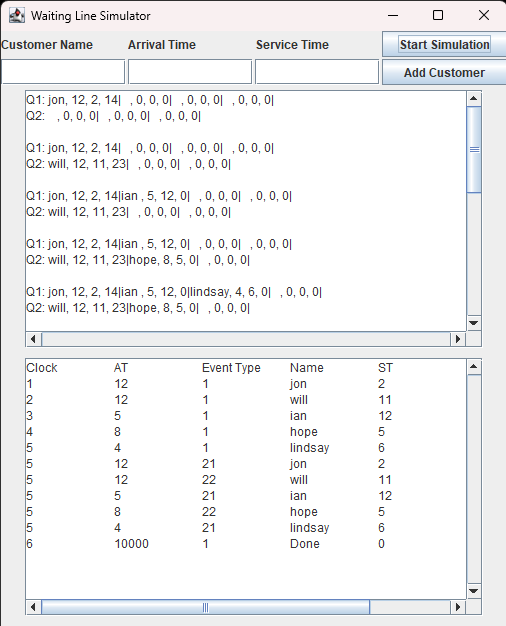
The Waiting Line Simulator is a Java application designed to replicate real-world customer queues in a service setting. This interactive program enables users to input customer details, including arrival and service times, and then simulates the flow of customers through two distinct queues. Developed using Swing components, the simulator offers a user-friendly interface with text fields, buttons, and text areas.
At the core of the simulator is the Node class, representing individual customers with attributes like name, arrival time, service time, and departure time. The Queue class manages these customer nodes, offering functionalities for adding and removing customers and calculating average wait times for each queue and both queues combined.
The Java-based Waiting Line Simulator dynamically replicates real-world customer queues, offering valuable insights into queue performance and optimization.
A key feature of the simulator is its ability to visualize and analyze queue performance, offering insights into customer wait times and queue lengths. This functionality makes it a valuable tool for businesses seeking to optimize their service operations and improve customer satisfaction.
Looking ahead, future enhancements to the simulator could include real-time simulation capabilities, advanced queue management features, and tools for in-depth data analysis. Overall, the Waiting Line Simulator showcases fundamental concepts of data structures, GUI development, and simulation programming in Java, making it a compelling addition to any portfolio highlighting software development skills and problem-solving abilities.